 English
 Español
 Português
 русский
 Français
 日本語
 Deutsch
 tiếng Việt
 Italiano
 Nederlands
 ภาษาไทย
 Polski
 한국어
 Svenska
 magyar
 Malay
 বাংলা ভাষার
 Dansk
 Suomi
 हिन्दी
 Pilipino
 Türkçe
 Gaeilge
 العربية
 Indonesia
 Norsk
 تمل
 český
 ελληνικά
 український
 Javanese
 فارسی
 தமிழ்
 తెలుగు
 नेपाली
 Burmese
 български
 ລາວ
 Latine
 Қазақша
 Euskal
 Azərbaycan
 Slovenský jazyk
 Македонски
 Lietuvos
 Eesti Keel
 Română
 Slovenski
 मराठी
 Srpski језик

Call Us
+86-512-62870424
Email Us
jane@soundbetter.cn

How Do PET Acoustic Panels Absorb Sound, and How Should You Specify Them?
Acoustic Materials
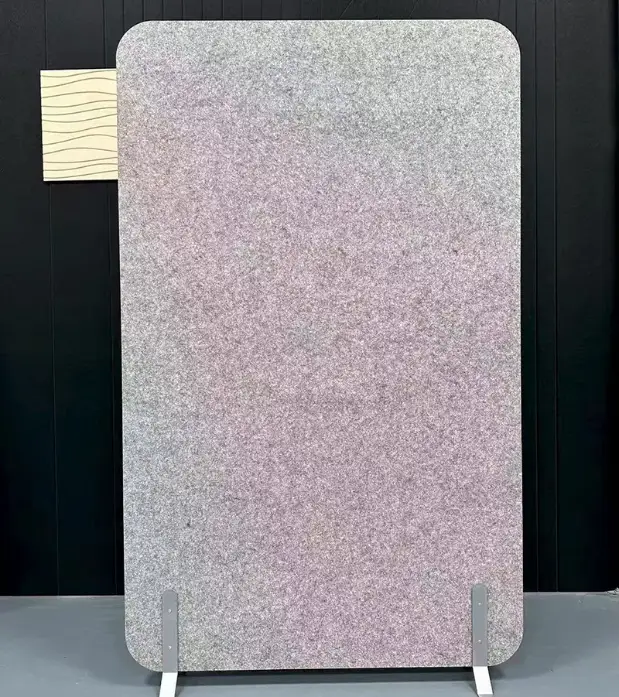
Quiet rooms are built from small decisions, surface by surface and detail by detail. PET Acoustic Panels are polyester-fibre absorbers that behave like a soft textile yet install like a finished architectural product: thin, dimensionally stable, and easy to fold into walls, ceilings, and bespoke shapes. The pages below cover the material itself, the physics behind absorption, the rooms where it earns its place, and the choices that decide whether a space ends up calm or merely muffled.
Table of Contents
Click any line to jump straight to that section.- 1.What Is a Polyester Fibre Absorber, Exactly?›
- 2.How Does Absorption Work, and Why Isn’t It Blocking?›
- 3.Which Rooms Benefit Most?›
- 4.How Should the Panels Be Fixed and Laid Out?›
- 5.Why Not Foam, Fiberglass, or Mineral Wool?›
- 6.How Thick, How Dense, How Much Coverage?›
- 7.How Do They Age, Clean, and Affect Air Quality?›
- 8.Frequently Asked Questions›
1.What Is a Polyester Fibre Absorber, Exactly?
Strip away the branding and the answer is simple. The sheet is a mat of needle-punched polyester fibre, thermally bonded into a dense, wool-like felt. A large share of that fibre comes from recovered polymer, which is why the material is often described as an upcycled textile rather than a foam substitute.
Nothing about the construction is complicated, and that is precisely its appeal. There is no facing film, no fragile cell structure, no chemical binder holding crumbs together. What you hang on the wall is essentially a very well engineered piece of fabric that happens to be thick enough to do acoustic work.
The Build-Up, Layer by Layer
The process begins with loose fibre. Needles punch it into a coherent batt, heat fuses the surface into a stable skin, and the finished mat holds its shape without a separate adhesive film. Well-made sheets avoid formaldehyde-based bonding, a detail that matters later when the conversation turns to indoor air and occupied buildings.
Standard sheets run 1,220 mm by 2,440 mm in 9 mm and 12 mm thicknesses, with laminated multi-layer boards and larger formats available for ceilings and shaped features. Density sits in a narrow working band: light enough to hang on a plasterboard wall, dense enough to absorb energy instead of fluttering against it.
Colour is dyed through the fibre rather than printed on top, so a cut edge reads almost the same as the face. That single behaviour is why the material survives close inspection in a reception area, a showroom, or a boardroom where the detailing is meant to be seen.
What the Material Is Not
It is not a barrier. It will not silence a noisy neighbour through a shared wall, and expecting that is the fastest route to disappointment. It is not structural, not waterproof, and not a replacement for cavity insulation behind the finish.
Treat it as a surface with an acoustic job and the detailing becomes straightforward. Treat it as a cure for every noise complaint in the building and the project will end with a room that is softer but no quieter.
2.How Does Absorption Work, and Why Isn’t It Blocking?
Sound indoors behaves less like a straight line and more like weather. It spreads, meets a surface, and either passes through, bounces back, or is soaked up. That third outcome decides whether a room feels calm or cavernous, and it is the only one these panels are designed to influence.
Absorption and Insulation Are Different Jobs
Two products are routinely confused. An absorber removes energy that is already inside the room, shortening the tail of every clap, chair scrape, and spoken sentence. An insulator keeps energy from crossing into the neighbouring room in the first place. One changes the character of a space. The other changes what escapes it, and no amount of surface treatment will substitute for the second.
Most complaints framed as soundproofing are really complaints about reverberation. A voice reaches the listener twice, once directly and once a fraction of a second later off a hard surface, and the two arrivals blur the syllables. Absorption removes the second arrival, and intelligibility returns without a single change to the wall assembly.
PET Acoustic Panels sit firmly on the absorption side of that line. They make a room easier to listen in, easier to speak in, and easier to record in. They do not make a room silent, and any specification that promises silence is describing a different product.
What Happens to a Wave
A porous absorber works through friction. Air pushes into the open structure of the felt, the fibres resist that movement, and a small amount of acoustic energy converts to heat. The effect is strongest where air velocity is highest, which is roughly a quarter of a wavelength away from a hard surface.
That is the physical reason an air gap behind a panel matters as much as the panel itself. Mounted flat, the material works where it is; mounted on battens, the same thickness reaches deeper into the low mid-range, because the cavity gives the wave room to move before it is damped.
Low frequencies carry long wavelengths and demand depth, so no thin sheet will tame a room mode at 60 Hz. High frequencies carry short wavelengths and are absorbed readily, sometimes too readily. Heavy treatment with thin material produces the classic failure: a room that is dull at the top and still boomy at the bottom.
Reading the Ratings Honestly
Published absorption data is measured in a reverberation chamber, in a stated mounting, at a stated thickness. A single averaged number describes the middle of the band. It does not tell you what happens at 125 Hz, or how the panel behaves when it is glued directly to plasterboard instead of sitting on a cavity.
Ask for the third-octave curve, and ask which mounting method produced it. A curve plotted for a 12 mm sheet on a 50 mm cavity is a very different product from the same sheet bonded flat, and both are legitimate, as long as the drawing matches the test.
| Build-Up | Absorption Character | Strongest Range | Where It Fits |
|---|---|---|---|
| 9 mm sheet, direct fix | Moderate, speech-weighted | Upper speech band | Low-ceiling offices, wall accents |
| 12 mm sheet, direct fix | Fuller control of vocal energy | Speech and vocal | Boardrooms, classrooms, reception walls |
| 12 mm on 25 to 50 mm cavity | Noticeably stronger low mid | Vocal plus lower mid | Studios, auditoria, music rooms |
| 24 mm laminated board | Extended low-frequency reach | Wide band | Broadcast, rehearsal, performance spaces |
| Baffle or cloud, open on both sides | Two-sided absorption with air behind | Wide, volume-dependent | Atria, halls, large industrial rooms |
3.Which Rooms Benefit Most?
How a room is used matters more than how large it is. A small room with a hard shell and parallel walls can be far more punishing than a big hall with soft details, and the treatment plan should follow the complaint rather than the floor area.
Rooms Where Speech Is the Problem
Speech is a narrow signal. Consonants live in the upper band, vowels in the lower middle, and a listener needs both to separate similar words in a noisy environment. Rooms that punish speech are usually mid-sized, hard-surfaced, and lined with parallel planes: a boardroom facing a glass curtain wall, a classroom over a tiled floor, a call centre under a low acoustic ceiling.
In these spaces the fix is rarely total coverage. Two facing walls, the rear wall behind the speaker, and part of the ceiling are enough to pull the tail down and restore the shape of each syllable.
Rooms Where Music Is the Problem
Music asks for a wider band and a shorter decay, and the low end is where thin treatment gives up. Rehearsal rooms, home studios, and performance spaces need depth, an air gap, and coverage placed where reflections actually arrive rather than where the wall looks emptiest.
Rooms Where the Ceiling Is the Only Free Surface
Open-plan offices rarely permit wall treatment. The ceiling is the one plane the acoustician can reach without interrupting the furniture plan, which is why clouds, rafts, and baffles dominate that typology. Hanging them with open sides does more work than bonding them flat, because sound reaches both faces and the volume behind becomes part of the absorber.
| Space | Dominant Problem | Practical Starting Point |
|---|---|---|
| Open-plan office | Speech spill between workstations | Ceiling clouds over clusters, wall bands near meeting zones |
| Meeting and board room | Flutter echo, hard speech | Perimeter treatment on two opposing walls |
| Classroom | Reverberation, listening fatigue | Rear wall panels plus partial ceiling coverage |
| Recording or broadcast room | Early reflections off the desk and wall | Panels at first-reflection points, cavity behind |
| Restaurant or cafe | Rising background level through the evening | Ceiling-first treatment, absorbent booth backs |
| Lobby or atrium | Long tails in a large volume | Suspended baffles and rafts at height |
| Home studio | Small-room colouration | Thick panels with depth behind the mix position |
| Gym or multi-purpose hall | Hard echoing shell, high occupancy noise | Baffle grid plus wall bands at head height |
4.How Should the Panels Be Fixed and Laid Out?
The fixing method changes measured performance as much as thickness does. A drawing that specifies the sheet but not the substrate leaves the acoustic result to the installer, and the installer will choose the fastest route.
Direct Fix, Battened Fix, or Framed Assembly
Direct fix: the panel is bonded or pinned flat to a solid substrate. Fast, thin, and visually tight, with the weakest low-frequency behaviour of the three options. Best for ceilings with limited depth and for walls where the complaint is speech rather than bass.
Battened fix: the panel sits on timber or metal battens, leaving a sealed cavity behind. The panel absorbs the surface and the cavity extends the working range downwards. This is the default for studios, music rooms, and any space with a low-end problem.
Framed assembly: the panel is held inside a frame with an open back or a fabric-wrapped return. It reads as a designed object rather than a finish, and it can be demounted, re-shaped, or moved as the room changes.
Ceilings, Clouds, and Baffles
On a ceiling, weight and fixing geometry decide the detail. Even at 12 mm, PET Acoustic Panels add only a few kilograms per square metre, so a plasterboard ceiling or a standard suspended grid will normally carry them without structural work. Clouds and rafts hang on stand-offs or wire, and baffles drop vertically to break up a large volume.
Layout Rules That Change the Result
- Find the reflections before you find the panels. Clap in the room, listen for the surfaces that answer back, and mark those planes rather than distributing material evenly like wallpaper.
- Cover one plane of each opposing pair. Two treated surfaces facing each other kill flutter faster than four small patches scattered around the perimeter.
- Keep a rhythm. Panels at regular intervals with deliberate gaps read as a system; panels in irregular clusters read as an afterthought.
- Leave the edges honest. Reveals, shadow gaps, and consistent joints make a soft material look architectural, and they make later replacement possible.
- Detail the transitions. Corners, skirting junctions, and ceiling interfaces are where a felt finish either looks finished or looks improvised.
A layout that ignores the room geometry will underperform a simpler layout that follows it, even with identical material and identical thickness.
5.Why Not Foam, Fiberglass, or Mineral Wool?
Every absorber family has a place, and the honest comparison is not about which one absorbs the most sound in a laboratory. It is about which one survives the building it is specified into: the cleaning regime, the dust, the shape, the colour, and the person who has to cut it on site.
PET Acoustic Panels occupy a specific niche. They give a soft, machinable, dye-through surface that can be cut, pressed into three-dimensional forms, printed, and joined without a fabric wrap. Foam absorbs well and dates quickly. Fiberglass and mineral wool are excellent in a sealed cassette and unpleasant outside one.
| Property | Polyester Felt | Acoustic Foam | Fiberglass Board | Mineral Wool |
|---|---|---|---|---|
| Surface and touch | Soft textile, stable skin | Spongy, friable | Dusty, needs facing | Loose, needs facing |
| Cutting on site | Blade, guillotine, CNC | Knife, crumbles at edges | Special tools, irritant | Messy, irritant |
| Dust and loose fibre | Low | Degrades with age | Requires full encapsulation | Requires full encapsulation |
| Moisture behaviour | Stable, dries quickly | Can crumble when damp | Needs protection | Needs protection |
| Design freedom | Dyed colour, 3D forms, print | Limited shapes, colour on surface | Boxed and wrapped | Hidden behind fabric |
| Recycled content | High, from recovered polymer | Usually low | Moderate | High, from process by-product |
| Repair strategy | Swap one panel | Re-do the area | Re-wrap the cassette | Re-panel the bay |
The table points to a pattern. Where the acoustic surface is also the visible finish, polyester felt removes a layer from the build-up and with it a layer of risk. Where the surface is hidden behind a perforated metal tray, mineral wool remains the rational choice and always will.
There is also the question of what happens after installation. A material that sheds fibre into the air of an occupied room is a maintenance liability dressed as an acoustic product. A material that can be wiped, vacuumed, and re-cut keeps its appearance and its performance for the length of the fit-out.
6.How Thick, How Dense, How Much Coverage?
Three variables decide the outcome, and they are usually discussed in the wrong order. Thickness comes first in most conversations because it is the number on the datasheet, but thickness only pays off once coverage and placement are right.
Begin With the Room, Not the Board
Measure the volume, count the hard planes, and identify where listeners sit relative to the speakers and to each other. A 40 square metre meeting room with a glass wall needs a different plan from a 40 square metre studio with the same floor area, and the difference lives entirely in placement.
Thickness, Density, and the Air Gap
At 9 mm the material is a speech-range tool: quick to install, visually light, and honest about its limits. At 12 mm it gains body in the vocal range and behaves better when mounted on a cavity. Beyond that, depth matters more than density, because the cavity extends the effective absorber thickness into the frequencies where thin sheets fail.
Density should be high enough to resist air movement and low enough to stay porous. Pushing density up to chase a number tends to reflect high frequencies off a hard surface and turn an absorber into a weak reflector.
Coverage: How Much Is Enough?
Coverage is expressed as a share of the total surface area, and the useful starting ranges are modest. Roughly a fifth of the total surface suits a quiet office. Around a third suits a classroom or a boardroom. Half or more belongs to studios, rehearsal rooms, and performance spaces, where the decay time is the design target rather than a side effect.
- Check the mounting, not only the sheet. The same panel performs differently bonded flat and hung on battens, so the drawing must state the cavity.
- Check the fire documentation. Request the test report for the exact build-up, including any adhesive or backing, not for the raw fibre alone.
- Check the cut edges. Whether edges are square, bevelled, or wrapped changes both the look and the joint detail between panels.
- Check the colour against the light. Dyed felt shifts under warm lighting, so approve the shade in the actual room rather than on a screen.
- Check the services. Light fittings, sprinklers, and sensors need coordination before the panel layout is frozen, not after.
7.How Do They Age, Clean, and Affect Air Quality?
Longevity is where the quiet argument for PET Acoustic Panels becomes a practical one. A surface that can be cleaned in place, re-cut after a fit-out change, and kept out of the waste stream for a decade is a surface that stays specified.
Cleaning Without Damaging the Fibre
Dust sits on the surface and stays there, which is the behaviour you want. A vacuum with a brush head on low suction removes it without altering the texture. Marks lift with a damp cloth and a neutral detergent, worked gently and blotted rather than scrubbed.
- Vacuum monthly in occupied commercial space, quarterly in low-traffic interiors.
- Avoid solvent cleaners, bleach, and abrasive pads, which flatten the skin and leave a visible patch.
- Blot spills from the edge inward so the mark does not spread through the felt.
- Keep the panel out of standing water; the material dries quickly but repeated soaking softens the bond.
- Re-cut rather than patch when a service penetration moves, and keep spare sheets from the same dye batch.
Indoor Air and Occupant Comfort
A polyester felt surface contributes almost nothing to off-gassing when it is bonded without formaldehyde adhesive, which is the specification to insist on for schools, healthcare, and any densely occupied room. The material is also non-allergenic in normal use and does not shed loose fibre the way aged foam does.
There is a secondary benefit that rarely appears in a specification: a porous surface is a poor reflector of airborne dust and a poor host for condensation, so it tends to stay cleaner than a hard finish in the same position.
Ageing, Fading, and Re-Panelling
Dyed fibre holds colour well under indirect light and less well under sustained direct sun, so façade-facing rooms deserve a shade review. Physical ageing is mostly about compression and impact: a panel that has been leaned on, knocked, or loaded will show a soft dent that does not recover.
The practical advantage appears at the end of a fit-out cycle. Individual panels can be replaced without touching the surrounding finish, and the removed sheet can return to the polymer stream rather than to a skip. That is a rare combination in acoustic finishes, and it is the reason the material keeps turning up in refurbishment work.
FAQFrequently Asked Questions
Six questions arrive in almost every enquiry. The answers below are deliberately short, because the honest version of each one fits in a paragraph.
1.Will these panels stop noise coming from the neighbouring room?
No, and no surface product will. Absorption changes what happens inside a room; it does not add mass or close a flanking path. If the complaint is a television audible through a shared wall, the work belongs in the wall assembly, the joints, and the penetrations. Absorption is the second step, not the first.
2.Can they be cut and shaped on site?
Yes. A sharp blade, a straight edge, and a steady pass will cut a 9 mm or 12 mm sheet cleanly, and a guillotine or CNC gives a production-grade edge. Curves, notches, and service cut-outs are all practical, which is why the material suits retrofit work where nothing measured on the drawing matches the wall.
3.Are they suitable for ceilings?
Yes, in three forms: bonded to a solid ceiling, hung as clouds and rafts on stand-offs, or dropped as vertical baffles. Weight is modest enough for a standard suspended grid, but the fixing detail still needs to be designed for the substrate rather than assumed.
4.Does an air gap behind the panel actually help?
It does, and measurably so in the low mid-range. A sealed cavity of 25 to 50 mm lets the wave move before it is damped, which extends the effective working thickness without adding material. Mounted flat, the panel still works, just over a narrower band.
5.How many panels does a room need?
Start from coverage rather than panel count. A quiet office usually needs about a fifth of the total surface area, a classroom or boardroom about a third, and a studio or rehearsal space half or more. Then place that coverage where reflections actually arrive, because location outperforms quantity.
6.Can they be used outdoors or in wet areas?
They are interior products. Occasional humidity is tolerated, sustained wetting is not, and direct rain or poolside splash will soften the bond and stain the face. For sheltered semi-exterior use, the detail needs a drained cavity and a protective overhang rather than a heavier sheet.
Next step
Bring the room drawing. We will bring the thickness, the layout, and the fixing detail.
Rooms are rarely fixed by a single product, and they are never fixed by guessing. Soundbetter develops and manufactures polyester fibre acoustic systems for walls, ceilings, baffles, dividers, and shaped features, and works from project drawings rather than stock sizes. If the ceiling grid is about to close and the finish schedule still has a gap, the quickest route is a room plan and a short technical conversation.
Send Inquiry



X
We use cookies to offer you a better browsing experience, analyze site traffic and personalize content. By using this site, you agree to our use of cookies.
Privacy Policy
News
 How Do PET Acoustic Panels Absorb Sound, and How Should You Specify Them?2026/11/20
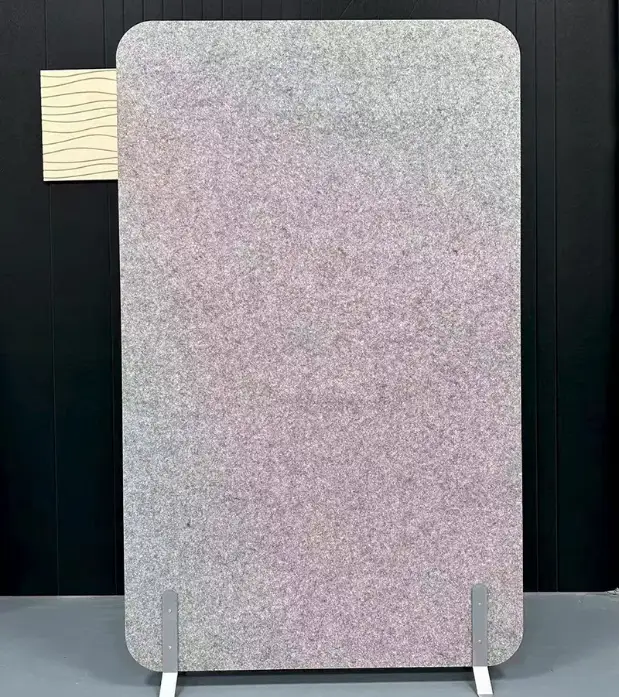
Quiet rooms are built from small decisions, surface by surface and detail by detail. PET Acoustic Panels are polyester-fibre absorbers that behave like a soft textile yet install like a finished architectural product
 Why Are PET Acoustic Fibre Panels Becoming the Smartest Solution for Modern Acoustic Design2026/05/26
One of the most innovative acoustic materials leading this transformation is the PET Acoustic Fibre Panel. Known for its exceptional sound absorption, eco-friendly manufacturing, stylish appearance, and versatile applications, this modern acoustic panel has quickly become a preferred solution worldw......